Sunday, April 24, 2011

Happy Bunny Egg Day

We dyed a dozen of our hens' eggs this weekend.  I'm pretty sure it's the first time we've ever dyed brown eggs, but they came out brilliant.


They made for a tasty breakfast.

Saturday, April 16, 2011

Cold Frame Progress

It's been about a month since I planted some kale under the glass and its looking pretty good.


I absolutely love this kale! We collected the seeds from our biennial kale in its second season.  It grows a thick almost shrub like trunk at the base and sprouts new leaves late into the fall. The flavor is less bitter than most store bought kale and it self seeds like crazy.

In the center you can see some baby cabbages.  It may look really crowded in there but the cabbage is an early maturing miniature cabbage.

Thursday, March 17, 2011

Early Season Experiment

This past holiday season the Gardness' family gave me a copy of The Winter Harvest Handbook. It's quite an amazing book that details the steps employed by Eliot Coleman to not only extend the growing season in Maine but to actually grow greens all year round.  We didn't manage to test out the deep winter growing techniques but we were inspired to build our first cold frame.


Motivated to keep it as cheap as possible, I dug around the basement and found two matching picture frames. The sides are made from a 2x6 with a bit of 2x4 that I ran through the table saw to angle the glass. It's small but the hope is to make several others, possibly using plexiglass poster frames. On a sunny day when the air temperature was around 55° we saw it as high as 95° under the glass.

This past weekend I planted a few kale seeds in the frame so we'll be watching and waiting for any sprouts.

Flowers of Spring


The perennials planted by my late aunt have started their annual bloom around the homestead.  Spring is indeed upon us!

Tuesday, February 8, 2011

Tree Taping Time

I think we are all starting to come out of our hibernation a little lately.  Even though there is a bit of snow on the ground the trees are starting to wake up.  This week, depending on the weather, we will be tapping a few of our maple trees.  We're waiting for the temperature changes to be just right.  Maple sap flows when daily highs are above freezing and nightly lows are below freezing consistently.

Last year we were able to freeze a bit of sap that we recently boiled down into syrup.  It took nearly 3 gallons of sap and about 5 hours to make 3/4 of a bottle of syrup.  

It was really an easy process. We simply filled a large pot with sap, put it on the stove, set up a fan to blow the moisture away from the cabinetry and let it boil.


The syrup is a little cloudy because we didn't bother to filter it.  It has a very rich and creamy maple flavor a bit like maple fudge with a slight chocolaty flavor in there somewhere. The results are wonderful and far better than I had expected.

Friday, November 5, 2010

Cider

Wow, how time gets away from us these days.  If there is a busier time of year than Spring for us, it's definitely Autumn.  One of the big projects I had been planning for ages was to brew a batch of hard cider from scratch.  As I watched the apples ripen this summer I finally took action.

The most important piece of the process was to procure a press.  With a limited budget and a DIY spirit I planned out a simple press made from common hardware store items.  One thing I realized pretty quickly is that there is more than one way to crush an apple.  In the States we usually see cider presses made from a barrel of wood slats inside a cast iron frame.  This design clearly didn't lend itself to our budget or abilities.  The more exciting cider press design is the sort used widely in the UK.  It is basically two boards with a bag of apple pulp in between.  For around $50 I was able to gather the needed pieces to throw together a plywood and 2x4 bottle jack powered cider press.


Note: The plywood I used is made from oak.  I've read using pine can hurt the flavor of the cider.

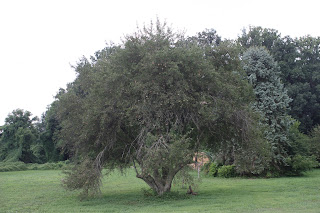
After collecting two large shopping bags full of apples from our aging, unhealthy, unidentified apple tree, we were in business.

With the help of a couple of friends we crushed the apples in a bucket using the advanced "log jamming" technique (similar to the process employed by Native Americans to crush corn). Once crushed the apple pulp was put in a nylon mesh bag (the sort used to filter wine grapes).  The squeezing process was started and continued until the 2x4s gave creaking and popping sounds that let us know the maximum pressure had been reached.

We pasteurized the raw cider just because we're sissies.  We then pitched some cheap Nottingham Ale Yeast that was laying around in the fridge.  The result was a slightly sour but intoxicating dry cider.  While not a great brew, I suspect the final result had more to do with the poor quality of the apples and yeast selection than with the process or equipment.  Though I'm completely satisfied with our efforts, it's a shame we will probably have to wait another year before we can experiment further.

Sunday, August 8, 2010

Planning for Canning

I know the beginning of August is still smack in the middle of the summer season, but for some reason, to me, it always feels like the very edge of Autumn. I think it has something to do with the fact that, as the harvests start coming in, it becomes time to start freezing and canning in preparation for winter, and planting fall crops in the spaces that have been opening up in the garden. The days are already noticeably shorter, and the apples are starting to weigh down the branches of our old Duchess tree.

Thus, the Gardener has built an inexpensive little cider press and we've been experimenting with our windfall apples. We've collected a little more than a gallon of juice, and in the next few days we'll try making our first batch of hard cider.

This past week we've also received our first share of fruit from the North Star Orchard CSA. In our bag were Summer Blaze and Redfree apples, Red Haven and White Lady peaches, Vanette and Oullins plums, and Delight pears. Though we're really enjoying eating these fruits as they are (fresh, crisp, and juicy!), I've also been planning out how I'm going to can some of them for winter. For the most part, I think I'm going to keep my recipes pretty simple, to highlight the natural flavors of each variety of fruit, but I've also got plans for some more interesting spreads like honeyed yellow tomato butter, which I'm thinking will go well with our almost-done-aging farmhouse cheddar.


What else makes it feel like the start of Fall? 45 pounds of Desiree, Carola, and Yukon Gold potatoes harvested and stored away, that's what!